The 2026 World Cup kicks off on June 11 and runs to July 19, spread across the USA, Canada and Mexico for the first time ever. If you’re following your team across borders, picking the best eSIM for FIFA World Cup 2026 is one of the few trip decisions you should lock in before you fly — because the wrong plan means roaming bills, data that runs out mid-tournament, or a “North America” plan that quietly leaves out one of the three host countries.
This is a straight, honest North America eSIM comparison: real prices, real data caps, and real coverage for an eSIM for USA, Canada and Mexico. We put SiM Claire head-to-head with Airalo, Holafly, Saily, Nomad, aloSIM and Jetpac so you can see exactly what your money buys.
Short on time? For most fans staying two to four weeks, SiM Claire’s 30 GB total for 30-day plan covers all three host countries on one eSIM at ~$50 USD — competitively priced, and (unlike some “North America” plans) it actually includes Mexico.
Already know how much data you need and just want city-by-city coverage and setup steps? Read our companion Football Fan Travel Guide 2026 — this article focuses purely on comparing providers and pricing.
Why you need an eSIM for the FIFA World Cup 2026 (and not roaming)
Turning on your home carrier’s roaming for a few weeks in North America can quietly run into the hundreds of dollars — and many plans throttle or cap you anyway. A travel eSIM sidesteps all of that:
One eSIM, three countries. No swapping SIMs at the border between group-stage and knockout cities.
Prepaid and predictable. You pay once, up front, in your own currency. No surprise overage charges after the trip.
Installed in minutes. Set it up before you fly and it activates when you arrive.
Keep your number. Your physical SIM or primary line stays active for calls and texts while the eSIM handles data.
For a tournament that involves maps, ride-hailing, live scores, streaming, group chats, and uploading every goal celebration, data is the one thing you can’t afford to run out of.
Why World cup 2026 needs different kind of eSIM
Every previous tournament happened in one country with one mobile network. 2026 is three countries, 16 host cities, and up to three separate sets of roaming charges if you’re unprepared. That changes what “good value” looks like in a travel eSIM 2026:
It must cover all three host nations on one plan. Some providers label a plan “North America” but only include the USA and Canada — leaving you offline the moment you cross into Mexico. Always confirm Mexico is listed.
Match the data to your trip. A month of maps, ride-hailing, group chats, live scores and social uploads adds up — most fans want a daily allowance or a 20 GB+ bucket, not a 7-day plan.
Match the duration to your stay. Most fans need 20 to 30 days.
(For a full city-by-city coverage breakdown and a match-day data calculator, see our Football Fan Travel Guide 2026 — we won’t repeat all that here.)
SiM Claire vs the major eSIM brands: North America price comparison
Prices are shown in CAD and USD, for plans covering the USA, Canada and Mexico, as of June 2026. Each provider’s native currency is exact; the converted figure is approximate (USD→CAD ≈ 1.38, EUR→CAD ≈ 1.61). eSIM prices change often — always confirm on the provider’s own site before buying.
Entry plan — 10 GB for 30 days
Good for fans leaning on hotel and stadium Wi-Fi who just need maps, messaging and scores.
At ~$50 USD, 30 GB total, SiM Claire gives more data than Nomad’s 20 GB plan for a similar price, and beats Airalo, Saily and Holafly on value — the best value in this comparison for a full month around 30 GB.
SiM Claire’s 40 GB and 60 GB daily plans beat Airalo, Saily and Holafly on price, with the simplicity of a fixed daily allowance and guaranteed three-country coverage. At the very top end (90 GB), SiM Claire and Holafly’s unlimited month are within a few dollars — choose based on whether you prefer a predictable daily allowance or true unlimited.
Explore all options on the SiM Claire United States eSIM page. Choose United States as the destination, then pick a plan marked 3 Countries (USA, Canada, Mexico). Extending your trip? Some SiM Claire plans cover 6 countries, adding Panama, Costa Rica and El Salvador.
SiM Claire vs Airalo, Holafly, Saily, Nomad, aloSIM & Jetpac
Searching “Saily vs Jetpac” or “SiM Claire vs Airalo”? Here’s the honest rundown for a three-country trip (as of June 2026):
SiM Claire vs Airalo — Airalo has the biggest country catalogue and does offer larger North America plans (up to ~50 GB), but at a higher price than SiM Claire’s daily plans for comparable data.
SiM Claire vs Holafly — Holafly is genuinely unlimited but priced per day (about CA$136 for 30 days) and throttles after a daily fair-use limit. Convenient, but a premium versus SiM Claire’s fixed plans.
SiM Claire vs Saily — Saily (by the NordVPN team) offers up to 20 GB plus unlimited options for North America with Mexico included, and has built-in security features — typically at a higher price than SiM Claire’s comparable daily plans.
SiM Claire vs Nomad — Nomad is reliable, with fixed plans up to 20 GB plus unlimited day-passes; its 20 GB month is priced similarly to Sim Claire’s 30 GB plan, but with less data.
aloSIM — Offers maximum data of 10 GB for 30 days priced at $55 which is more than SiM Claire , Airalo & Nomad.
SiM Claire vs Jetpac — Jetpac’s North America plans cover only the USA and Canada — not Mexico — so they don’t work for the full three-host-country trip, regardless of price.
The takeaway: several providers can carry the data, but coverage and pricing models differ a lot. SiM Claire’s edge is a simple, fixed daily allowance with guaranteed three-country coverage including Mexico, priced transparently in CAD.
Why SiM Claire eSiM is a smart pick for World Cup 2026 travel
Guaranteed three-country coverage (USA + Canada + Mexico) on one plan — plus a 6-country option that also covers Panama, Costa Rica and El Salvador.
Simple daily high-speed plans — fresh data every day, with no monthly cap to ration.
Competitive value — cheaper than Airalo, aloSIM, Saily and Holafly on the popular plans we compared (June 2026).
SiM Claire North America plans at a glance:
One eSIM. USA + Canada + Mexico. Pick the plan that fits your trip:
*CAD; USD figures are an approximate conversion (~1 USD = 1.38 CAD) and your card’s exchange rate at checkout may differ slightly.
Daily plans deliver high-speed data each day and reset every 24 hours — you start every matchday fresh. See live plans on the SiM Claire United States eSIM page.
How to set up your SiM Claire eSIM in 3 steps
Choose your plan
Select you plan on simclaire.com. Complete checkout — your eSIM is delivered instantly by email and QR code.
Activate before you fly
While you’re on stable Wi-Fi at home, install the eSIM by scanning the QR code.
Land and connect
Switch on the eSIM and turn on data roaming for the SiM Claire line — you’re online the moment you arrive, in any of the three host countries.
World cup 2026 travel eSIM – Frequently asked questions
Does one SiM Claire eSIM really work in the USA, Canada, and Mexico?
Yes. Every SiM Claire North America plan covers all three host countries on a single eSIM, so you stay connected as you move between group-stage and knockout cities — no SIM swapping at the border.
How much data do I need for the FIFA World Cup 2026?
For a week relying mostly on Wi-Fi, 10 GB is fine. For two to four weeks of maps, ride-hailing, social media, and streaming, a daily plan (1–3 GB/day) is the sweet spot. Heavy streamers and people tethering a laptop should look at the 2–3 GB/day options. SiM Claire offers the best eSIM value plans covering North America which ensures that you are adding more to travel your experience than just spending money on connectivity.
Which is the most popular and affordable eSIM plan for World cup 2026 ?
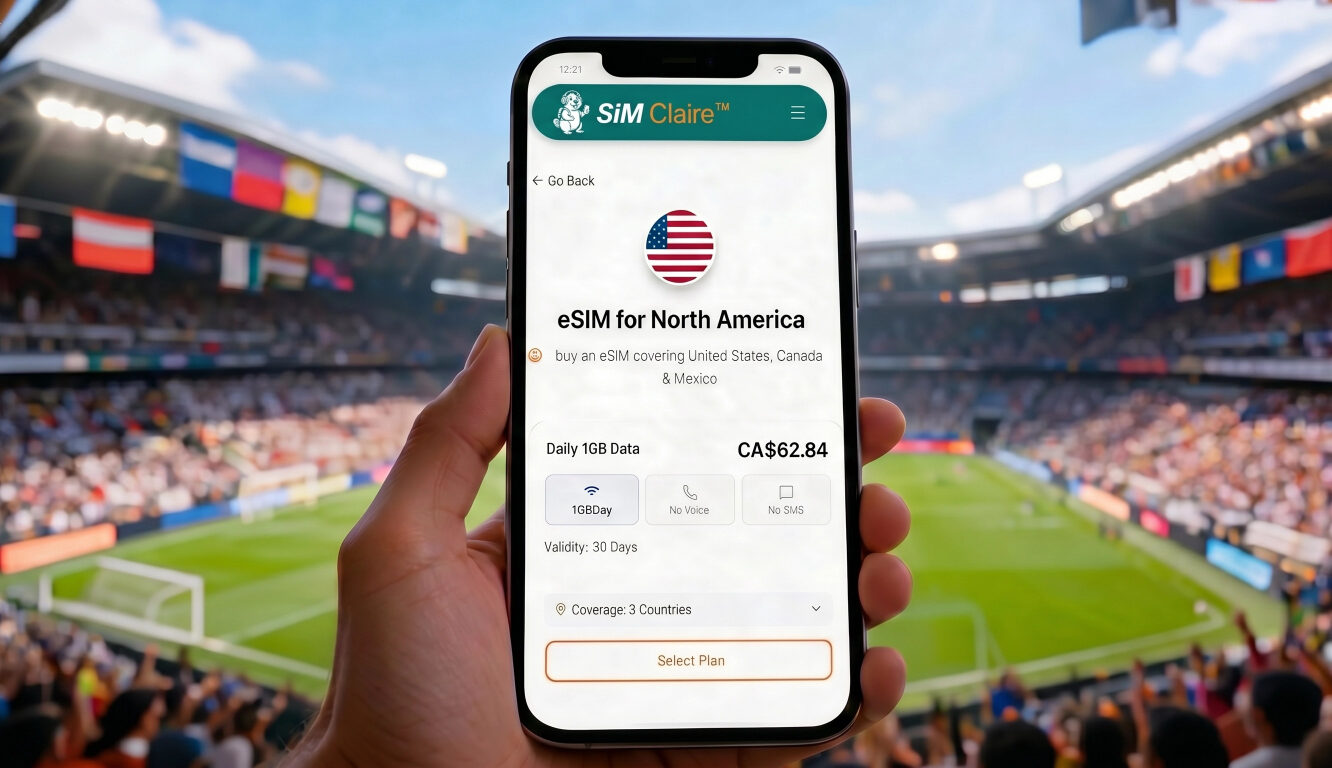
Best overall — Total 30GB, CA$70.37/~50.81 USD (30 days) The standout. A big 30GB pool you can burn however you want (no daily cap), valid for 30 days, covering all three host countries. Ideal for a fan attending matches across cities over several weeks with maps, rideshare, social, and some streaming. Best value — Total 10GB, CA$39.37 (30 days) Amazing if you’re a lighter user who’s mostly on hotel/stadium WiFi. Cheapest 3-country option, full 30-day validity, and it undercuts what the big-name eSIMs charge for the same coverage. Best for heavier daily use — Daily 2GB, Total 40 GB, CA$70.70 (20 days)40GB total at basically the same price as the 30GB plan, with a generous 2GB/day. Great if your trip is ~20 days and you use data hard every day. (Step up to Daily 3GB, CA$92.91 / 20 days = 60GB if you’re a true heavy streamer.) 1 GB/day for 30 daysis also another option if your fine with daily cap of 1 GB as it is priced competitively at CA$60.91.
Is an eSIM cheaper than roaming for the tournament?
Almost always. Carrier roaming across three countries for several weeks can cost far more than a prepaid travel eSIM, and roaming often throttles your speed. A SiM Claire plan is a fixed, upfront price with no coverage surprises or hidden costs.
Will my phone work with an eSIM?
Most phones released in the last few years are eSIM-compatible, including recent iPhone, Samsung Galaxy, and Google Pixel models. Before you buy, get help on validating your device compatibility by visiting SiM Claire’s device compatibility checker.
Can I share my data / use a hotspot?
Yes — SiM Claire plans support hotspot and tethering, so you can share your connection with travel companions.
When should I install the eSIM?
Install it before you fly while you have stable Wi-Fi, then simply switch it on when you land. You don’t need to use it until you arrive.
Kick off your trip connected
The 2026 World Cup only happens once, across three countries, over 39 days — being offline at kick-off isn’t an option. For guaranteed USA + Canada + Mexico coverage, simple daily data, and competitive pricing, SiM Claire is a smart choice for fans heading to the tournament.
While browsing, focus on plans showing coverage for 3 countries — those cover all three host nations.
Prices and plan details are a snapshot as of June 2026. Competitor figures are converted from USD (~1 USD = 1.38 CAD) or EUR (~1 EUR = 1.61 CAD), using the closest comparable plan. eSIM pricing, data caps and coverage change frequently, so figures may differ by the time you read this — always confirm on the provider’s own site before purchasing. SiM Claire is an independent eSIM provider and is not affiliated with, endorsed by, or an official partner of FIFA or the FIFA World Cup. References to the World Cup are descriptive only, to indicate the event many travellers are attending.
An eSIM for Portugal is the smartest way to stay connected on your trip. Planning a visit to Portugal in 2026 and wondering if you actually need one — or whether you can just wing it with airport Wi-Fi? You’re not alone. This is one of the most common questions tourists ask before visiting, so we’ve answered every single one.
The short answer: yes, you need an eSIM for Portugal
You can survive without it. But you’ll spend your trip hunting for café Wi-Fi every time you need Google Maps, waiting in SIM card queues at the airport after a long flight, or paying your home carrier €10–15 per day in roaming fees.
An eSIM eliminates all of that and helps you avoid roaming charges in Portugal. You buy it online before you leave, scan a QR code, and land in Lisbon already connected. No queues, no passport registration, no guessing which airport kiosk has the best deal.
Here’s everything tourists ask about getting connected in Portugal — answered honestly.
The most common questions, answered
What is an eSIM and how does it work?
An eSIM (embedded SIM) is a digital SIM card built directly into your phone. Instead of pushing a tiny plastic card into a tray, you download a mobile plan onto your device — usually by scanning a QR code sent to your email. Your phone then connects to local networks in whatever country you’re visiting, just like a physical SIM would. The difference is that you set it all up from home, before you travel. Most phones made after 2020 support eSIM. This includes iPhone XS and newer, Google Pixel 3 and newer, and Samsung Galaxy S20 and newer.
How do I get internet in Portugal — do I need mobile data or can I rely on Wi-Fi?
Portugal has Wi-Fi in most hotels, cafés, and restaurants — but relying on it entirely is a frustrating strategy. Here’s why: You need navigation the moment you land: Whether you’re calling an Uber, finding your hotel, or figuring out the metro, you need data before you reach a café. Wi-Fi drops out when you’re moving: Trains, trams, beaches, and cobblestone streets in Lisbon’s Alfama neighbourhood don’t come with a Wi-Fi password. Public networks are slow and unsecured: In busy tourist areas, shared networks get congested. They’re also not ideal for anything sensitive like banking apps or travel bookings. You’ll pay “restaurant prices” for connectivity: If your only connected moments are when you’re sitting down somewhere spending money, you lose a lot of freedom. Bottom line: you don’t need data every second, but having it on your phone means your trip runs more smoothly, from landing to departure
Is Portugal good for eSIM coverage?
Yes — Portugal has excellent mobile infrastructure for a European destination. Whether you’re navigating the hilly streets of Porto, working from a beachside café in the Algarve, exploring the volcanic landscapes of Madeira or driving through the rural Douro Valley, you can generally expect excellent coverage. When you use an eSIM in Portugal, you aren’t relying on a weak satellite or a sketchy tourist network. Instead, your phone instantly connects directly to the country’s top major local networks—like MEO, NOS, or Vodafone. In practical terms: Lisbon and Porto: Full 4G/5G, fast speeds everywhere including tram routes and the metro Algarve coast: Strong 4G along the entire coastline — whether you’re cliff-jumping near Lagos, exploring the beaches of Albufeira, catching a ferry from Portimão, or flying in and out of Faro. Your Portugal eSIM keeps you fully connected across the entire Algarve region. Madeira and Azores: Reliable 4G in main towns like Funchal and Ponta Delgada; slower in mountain interiors Rural and inland areas (Alentejo, Serra da Estrela): Generally solid 4G, with occasional slower spots in very remote areas — download offline maps before heading deep inland Main highways and train routes: The Lisbon–Porto Alfa Pendular train keeps a 4G signal the entire journey For most tourist itineraries — cities, coast, wine country — coverage is consistently good. For most tourist itineraries — cities, coast, wine country — coverage is consistently good.
Can I just buy a SIM card at Lisbon Airport?
You can, and many tourists do. But there are real downsides worth knowing: Queues form at peak arrival times, especially at the Vodafone store, which is the most visible option in the arrivals hall Airport SIM cards tend to be more expensive than buying online or in the city centre — you’re paying a convenience premium Shops close after 10pm, so if you land late, you’re without data until morning You’ll need your passport for registration — one more thing to fumble with after a long flight You have to remove your home SIM if you don’t have a dual-SIM phone, which means losing access to your regular number An eSIM sidesteps every one of these issues. This is especially true for travellers flying into Faro Airport heading to the Algarve, or landing at Lisbon Airport after a long-haul flight — both airports see long SIM card queues during peak summer season. With a SiM Claire Portugal eSIM, you set it up at home before you travel and step off the plane already connected — no queues, no passport fumbling, no stress.
Is an eSIM cheaper than roaming with my home carrier?
Almost certainly, yes. Most major carriers — including Verizon, AT&T, EE, Telus, and Optus — charge between $10 and $15 per day for international roaming. A two-week trip to Portugal could cost you $140–$210 just to stay connected. If you’re looking for cheap internet in Portugal and want to avoid roaming charges entirely, a travel eSIM is by far the smartest and most cost-effective solution. SiM Claire plans are grouped as Data Only, Unlimited Portugal eSIM, and Combo (Voice + SMS). Daily data plans start from just $2.42, while unlimited data Portugal eSIM plans start from $15 for 3 days — perfect if you’re streaming, making video calls, or sharing your hotspot with travel companions.Check the current Portugal eSIM plans on SiM Claire to see the exact pricing for your trip length. The math is simple: roaming charges are a tax on not having planned ahead. So is a Portugal eSIM worth it? For any trip longer than two days, absolutely yes — the savings versus carrier roaming alone make it worthwhile, before you even factor in the convenience of landing already connected.
How much data do I actually need for Portugal?
This depends entirely on how you travel. Here’s a realistic breakdown:
Usage type
What you’re doing
Recommended data
Light
Maps, WhatsApp, occasional Google
1–3 GB per week
Moderate
Maps, social media, booking apps, some streaming
3–5 GB per week
Heavy
Frequent streaming, hotspot for laptop, video calls
10 GB+ per week
A few practical notes:
Offline maps save a lot of data. Download your Lisbon, Porto, or Algarve maps in Google Maps before you go. GPS doesn’t use data — it only needs data to load the map tiles.
Hotspot use multiplies consumption fast. If you’re tethering a laptop, budget at least 10 GB for a week.
Most hotels and restaurants have Wi-Fi — so you’re not streaming on mobile data 24/7.
For most tourists on a 7–10 day trip, a 5 GB plan covers everything comfortably.
Does my phone support eSIM?
Whether you need a Portugal eSIM for iPhone or a Portugal eSIM for Android, the good news is that most phones made in the last four to five years are fully compatible. Here’s a quick check by device: iPhone: XS, XR, and any newer model — all support eSIM. iPhone 14 and later (US models) are eSIM-only. Samsung: Galaxy S20, S21, S22, S23, S24, and the Z Fold/Flip series all support eSIM. Google Pixel: Pixel 3 and newer. Other Android: Many newer models from Huawei, Motorola, and OnePlus support eSIM — check your device settings under “Network & Internet” or “Mobile Data” for an “Add eSIM” option. One important note: if your phone is carrier-locked, you may not be able to use a third-party eSIM. Check with your home carrier first — most will unlock your phone for free if you ask.
Is it safe to use an eSIM? What if I lose my phone?
eSIMs are actually more secure than physical SIM cards in some ways — there’s nothing to physically remove or steal. If your phone is lost or stolen, contact your eSIM provider to suspend the plan. From a data security perspective, you’re connecting to the same NOS, MEO, or Vodafone networks that local Portuguese people use — there’s nothing different or more vulnerable about the connection itself compared to a physical SIM.
Can I use an eSIM and keep my normal number active?
Yes, if your phone supports dual SIM. Most modern smartphones do — you use your physical SIM for calls and texts from your home number, and the eSIM for data while you’re travelling. You can receive WhatsApp messages, calls, and banking verification codes on your usual number without interruption. If your phone is eSIM-only (like US iPhone 14 models), you’d need to manage this differently — but you can still keep your home number active through apps like Google Voice or WhatsApp calling.
Can I use my same Portugal eSIM if I want to travel Spain, or other European countries?
It depends on the plan you buy. SiM Claire offers both country-specific Portugal plans and Europe-wide regional plans that cover multiple countries on a single eSIM. If your trip includes Portugal plus Spain, France, or other European destinations, a regional Europe plan is often better value — you don’t have to buy a new eSIM every time you cross a border. Check the Europe eSIM options on SiM Claire to find a plan that fits your itinerary.
What’s the best prepaid eSIM for Portugal and how do I set it up?
SiM Claire’s prepaid Portugal eSIM data plan is one of the simplest to set up — it takes about five minutes and works on any eSIM-compatible iPhone or Android phone. Here’s the exact process: Go to simclaire.com and search for Portugal in the destination bar. Choose your plan based on how long you’re staying and how much data you expect to use Complete your purchase — SiM Claire accepts Visa, Mastercard, Apple Pay, and Google Pay Check your email for the QR code (arrives almost immediately) Install the eSIM before your trip: on iPhone, go to Settings → Mobile Data → Add eSIM → Use QR Code. On Android, go to Settings → Network & Internet → SIM cards → Add eSIM Don’t activate it yet — wait until you land in Portugal, then toggle the eSIM on. That’s when the clock starts on your plan. The whole setup happens at home, in your own language, before you’re jet-lagged and standing in an airport queue. Activating your Portugal eSIM is just as simple — once you land, go to your phone’s mobile data settings, toggle the eSIM on, and you’re connected instantly. That’s when your plan officially starts.
What if I run into trouble with my Portugal eSIM?
SiM Claire offers customer support via WhatsApp — so you can get help from wherever you are, without needing Wi-Fi on the device that’s having the problem (use a nearby café’s Wi-Fi or ask to use someone else’s phone if your data isn’t connecting). Most common issues resolve in minutes: switching between networks, toggling airplane mode, or re-enabling roaming in your settings
The honest comparison: eSIM vs local SIM vs roaming
Still deciding between a Portugal eSIM vs SIM card? This table breaks it down honestly — including the option most tourists regret choosing.
eSIM (SiM Claire)
Local SIM (airport)
Home carrier roaming
Setup
Before you fly
At the airport
Nothing to do
Cost
Low
Moderate (airport premium)
Very high
Queue/hassle
None
Yes — plus passport ID
None
Keeps your home number
Yes (dual SIM)
No (or inconvenient)
Yes
Works immediately on landing
Yes
Yes
Yes
Coverage in Portugal
NOS, MEO, Vodafone
One carrier
Varies
Best for
Most travellers
Budget long-stay trips
People who didn’t plan ahead
Ready to get connected?
Portugal is one of Europe’s most rewarding travel destinations — from Lisbon’s tiled neighbourhoods to the Douro Valley’s terraced vineyards and the Algarve’s golden sea caves. The last thing you want is to miss a boat tour booking window or wander the wrong way through Sintra because you couldn’t pull up a map.
Buying a Portugal eSIM before you fly is the single easiest way to guarantee you land connected and stress-free. Plans start from just $2.42/day — a fraction of what your home carrier charges for roaming.
Looking for the best eSIM for International Travel in 2026? This complete guide compares the top travel eSIM providers, including SimClaire, Airalo, Holafly, Saily, Jetpac, and Ubigi, so you can avoid expensive roaming charges and stay connected abroad with the right international eSIM plan.
What Is an eSIM?
An eSIM (embedded SIM) is a digital version of the traditional plastic SIM card. Instead of buying and inserting a physical card, you simply scan a QR code or use an app to download a data plan directly onto your phone — in minutes, from anywhere in the world.
Unlike a physical SIM, an eSIM is built into your device’s hardware. This means you can store multiple plans and switch between them without ever opening your phone. Most modern smartphones — including iPhone XS and later, Google Pixel 3 and later, and Samsung Galaxy S20 and later — support eSIM technology.
Why Use an eSIM for International Travel in 2026?
International roaming with your home carrier can cost anywhere from $10 to $30 per day. In contrast, a travel eSIM plan for the same destination often costs a fraction of that price. Here is why more travelers are switching:
No airport queues: Buy and install your plan before you even leave home.
Keep your home number active: Your physical SIM still works for calls and 2FA texts.
Instant activation: Most eSIMs activate the moment you land — or even earlier.
Multiple countries, one plan: Regional and global plans let you roam across continents without buying new SIMs at every border.
Cheaper than roaming: Plans start from as little as $1.99 for basic data packages.
Quick Comparison: Best eSIMs for International Travel in 2026
Here is a quick comparison of the best eSIM providers for international travel in 2026 based on coverage, pricing, activation, support, and traveler use cases.
Provider
Best For
Coverage
Data Type
Key Strength
SimClaire
Best overall travel eSIM
150+ destinations
Prepaid travel eSIM plans
Easy activation, traveler-focused support, and destination-based plans
Airalo
Global coverage
200+ countries and regions
Local, regional, and global eSIM plans
Wide international availability and app-based setup
Holafly
Unlimited data
160+ destinations
Unlimited data eSIM plans
Good for heavy data users and long browsing sessions
Saily
Privacy-focused travelers
150+ destinations
Travel eSIM plans
Simple app experience and privacy-focused positioning
Jetpac
Budget travelers
100+ destinations
Short-term travel eSIM plans
Low-cost options for selected destinations
Ubigi
Long-term and frequent travelers
200+ destinations
Local, regional, and global plans
Strong option for recurring travel and connected devices
Best eSIM for International Travel 2026: Why SimClaire Is Our Top Pick
Finding the best eSIM for International Travel in 2026 is now one of the most important decisions for modern travelers. Whether you are going on vacation, studying abroad, working remotely, or traveling across multiple countries, a reliable travel eSIM 2026 plan can save you from expensive roaming charges, airport SIM-card queues, and confusing local SIM registration processes.
A good international eSIM should be easy to install, affordable, fast, and backed by proper customer support. That is why our top recommendation for most travelers is SiMClaire.
SiMClaire is designed for travelers who want a simple and reliable eSIM for travelers experience. Instead of dealing with physical SIM cards or high roaming bills, you can choose your destination, buy a prepaid eSIM plan, install it before your trip, and activate mobile data when you arrive.
In this guide, we compare the best eSIM for International Travel in 2026, including SiMClaire, Airalo, Holafly, Saily, Jetpac, and Ubigi. We will also cover how to use eSIM while traveling, eSIM vs physical SIM for travel, the cheapest eSIM for international travel, and which provider is best for different travel needs.
Why SimClaire Is the Best eSIM for Travel in 2026
SimClaire is our top recommendation because it focuses on what travelers actually need: simple setup, prepaid international data, fast activation, and better support when compared with many large self-service eSIM platforms.
Many travelers only compare eSIM providers by price or country coverage. But when you are already abroad and your data does not connect, support becomes extremely important. A cheap eSIM is not useful if you cannot activate it or get help quickly.
SimClaire is a strong choice for:
First-time eSIM users
International tourists
Students traveling abroad
Business travelers
Remote workers
Families going on vacation
Travelers who want support during setup
Users who want to avoid roaming bills
If you want the best eSIM for international travel 2026 with a balance of ease, reliability, and support, SimClaire should be your first choice.
Best eSIM for International Travel 2026: Top Providers Compared
1. Best Overall eSIM for International Travel: SimClaire
Coverage: 150+ destinations Data type: Prepaid travel eSIM plans Best for: Overall travel eSIM experience, support, and simple setup
SimClaire is our number one choice for the best eSIM for international travel 2026 because it offers a simple and traveler-friendly way to stay connected abroad.
With SimClaire, you can select your destination, choose a prepaid eSIM plan, receive your installation details, and activate your data when you reach your destination. This makes it a strong option for anyone looking for a reliable international eSIM without the stress of buying a local SIM card after landing.
The biggest advantage of SimClaire is its support-focused experience. Many travelers are new to eSIM technology and may need help with QR-code scanning, installation, APN settings, or activation. SimClaire is better suited for users who want guidance instead of being left alone inside a large app-based marketplace.
Why SimClaire Is Better for Many Travelers
SimClaire is a better choice if you want:
Easy eSIM setup before travel
Prepaid data with no roaming surprises
Support during activation
Destination-based travel plans
A smooth buying experience
A reliable eSIM for travelers
Airalo, Holafly, Saily, Jetpac, and Ubigi are all strong providers, but SimClaire is the best overall option for travelers who value support, simplicity, and a clean purchase experience.
Best for: Travelers who want the best balance of support, setup, and international connectivity.
2. Best eSIM for Global Coverage: Airalo
Airalo is one of the most well-known travel eSIM providers and is often chosen by travelers who want broad international coverage. It offers local, regional, and global eSIM plans, making it useful for people visiting one country or multiple destinations in a single trip.
Airalo is a good option for travelers who prefer an app-based eSIM buying and activation experience. Its wide destination availability makes it especially useful for frequent travelers, backpackers, and users who want to compare plans across different regions.
Why Airalo is a good option
Airalo may be a good fit if you want:
Wide international eSIM coverage
Local, regional, and global plan options
App-based purchase and activation
A well-known travel eSIM brand
Flexible options for single-country and multi-country trips
Possible limitation
Airalo plans and support experience can vary depending on the destination, plan type, and local network partner. Travelers should compare data allowance, validity, and coverage details before buying.
SimClaire vs Airalo
Airalo is excellent for global coverage, but SimClaire is better if you want a more support-focused experience. If you are a first-time eSIM user or want help during setup, SimClaire may be the better choice.
Best for: Travelers who want maximum global coverage.
3. Best Unlimited Data eSIM for Travel: Holafly
Holafly is a popular choice for travelers who want unlimited data eSIM plans in selected destinations. It can be useful for users who rely heavily on mobile data for maps, messaging, browsing, ride-hailing apps, social media, and work-related travel needs.
Holafly is especially suitable for travelers who do not want to constantly monitor data usage during a trip. For tourists, business travelers, and digital nomads who need frequent internet access, unlimited data can be convenient.
Why Holafly is a good option
Holafly may be a good fit if you want:
Unlimited data options in supported destinations
A travel eSIM for heavy internet usage
Simple setup for short-term trips
A good option for maps, messaging, browsing, and social media
Less concern about running out of data
Possible limitation
Unlimited data plans may cost more than fixed-data eSIM plans, and hotspot/tethering rules can vary by destination and plan. Travelers should check plan conditions before purchase.
Airalo vs Holafly Comparison
In an Airalo vs Holafly comparison, Airalo is better for fixed-data plans and broad global coverage, while Holafly is better for unlimited data users. Airalo may be more flexible for light or moderate users, while Holafly is better for travelers who do not want to worry about data limits.
SimClaire remains the better overall recommendation if you want a balanced eSIM experience with simpler support and travel-focused setup.
4. Best Privacy-Focused Travel eSIM: Saily
Saily is a travel eSIM provider that focuses on simple international connectivity and a privacy-conscious user experience. It is suitable for travelers who want an easy way to buy and manage eSIM plans through an app.
Saily can be useful for tourists, students, and remote workers who want a straightforward eSIM option for international trips. Its simple setup process makes it a practical choice for users who are new to eSIMs.
Why Saily is a good option
Saily may be a good fit if you want:
A simple travel eSIM app experience
A privacy-focused eSIM brand
Easy plan purchase and activation
A beginner-friendly eSIM setup
A practical option for tourists and remote workers
Possible limitation
Saily may not always offer the same depth of plan variety as some larger eSIM marketplaces. Travelers should compare destination availability, data limits, and validity before choosing a plan.
5. Best Budget eSIM for International Travel: Jetpac
Jetpac is a useful option for travelers looking for affordable eSIM plans in selected destinations. It can work well for short trips, budget travel, and users who mainly need mobile data for essential travel apps.
Jetpac is suitable for travelers who want a low-cost eSIM for basic internet usage such as maps, messaging, email, hotel bookings, and transport apps. It may be especially useful for short vacations or single-destination trips.
Why Jetpac is a good option
Jetpac may be a good fit if you want:
Budget-friendly travel eSIM options
Short-term data plans
A simple eSIM for basic travel needs
Affordable connectivity for selected destinations
A practical option for tourists and light data users
Possible limitation
Jetpac may not be the best choice for every destination or for users who need very large data allowances. Travelers should check coverage, validity, and available plans before buying.
6. Best eSIM for Long-Term International Travel: Ubigional Travel
Ubigi is a strong option for frequent travelers, long-term travelers, and users who need mobile connectivity across multiple destinations. It offers local, regional, and global eSIM plans, which can be useful for people who travel regularly or need coverage beyond a single country.
Ubigi is also known for supporting connected devices in addition to smartphones, making it useful for some tablets, laptops, and connected cars where eSIM support is available.
Why Ubigi is a good option
Ubigi may be a good fit if you want:
Local, regional, and global eSIM plans
A good option for frequent international travel
Support for selected eSIM-compatible devices
Multi-country travel flexibility
A practical choice for long-term or recurring trips
Possible limitation
Ubigi may be more suitable for users who already understand eSIM setup and plan selection. Travelers should check device compatibility, destination coverage, and plan validity before purchase.
How We Compared the Best eSIMs for International Travel
To find the best eSIM for international travel in 2026, we compared leading travel eSIM providers based on coverage, pricing, plan flexibility, activation process, customer support, and overall suitability for international travelers.
Each provider was reviewed for key travel use cases, including short vacations, multi-country trips, business travel, student travel, digital nomad travel, and long-term international stays. We also looked at whether each eSIM provider offers local, regional, or global plans and how easy it is for travelers to install and activate the eSIM before or during a trip.
The goal of this comparison is to help travelers choose the best international travel eSIM based on destination, budget, data needs, and ease of use.
Our comparison criteria included:
International destination coverage
Local, regional, and global eSIM plan availability
Pricing transparency
Data allowance and validity options
Ease of eSIM installation and activation
Customer support availability
Suitability for tourists, students, business travelers, and digital nomads
Quick Comparison Table: Best eSIM for International Travel in 2026
Provider
Coverage
Starting Price
Best For
Recommendation
SimClaire
150+ destinations
Destination-based
Best overall travel eSIM with support
Top Pick
Airalo
200+ countries and regions
Around $4.50
Global coverage
Best for frequent country-hopping
Holafly
160+ countries / many destinations
Varies
Unlimited data
Best for heavy data users
Saily
Global, regional, and country plans
Low-cost plans available
Privacy + value
Best for privacy-focused users
Jetpac
150+ to 200+ destinations
Around $1 on selected plans
Budget travel
Best cheap eSIM option
Ubigi
200+ destinations
Flexible
Regional and long-term travel
Best for long-term travelers
Best Overall eSIM for International Travel: SimClaire
SimClaire is a strong choice for travelers who want a simple, prepaid eSIM for international travel without dealing with physical SIM cards, roaming charges, or complicated activation steps. It is especially useful for tourists, business travelers, students, remote workers, and digital nomads who need mobile data before or during their trip.
SimClaire offers destination-based travel eSIM plans, making it easier for users to choose a plan based on where they are traveling. Instead of searching for local SIM cards after arrival, travelers can install their eSIM before departure and activate it when they reach their destination.
One of SimClaire’s key advantages is its traveler-focused setup experience. For users who are new to eSIMs, clear activation instructions and support can make a major difference, especially when traveling internationally.
Why SimClaire is a good option for international travelers
SimClaire may be a good fit if you want:
A prepaid eSIM for international travel
Destination-based eSIM plans
Easy setup before your trip
No need to buy a physical SIM card abroad
A travel data option that helps avoid roaming charges
Support during eSIM installation and activation
A simple option for tourists, students, business travelers, and digital nomads
Who should choose SimClaire?
SimClaire is best for travelers who want a straightforward international travel eSIM with easy activation and destination-specific plans. It is a good option if you prefer a simple purchase and setup process instead of comparing complex roaming packages or buying a local SIM card after arrival.
Possible limitation
Like most travel eSIM providers, availability, speed, and network performance can vary by destination, local carrier coverage, device compatibility, and plan type. Travelers should always check eSIM compatibility and plan details before purchase.
How to Choose the Right eSIM for Your Trip in 2026
Choosing the right eSIM depends on your destination, data usage, budget, and support expectations. Before buying any travel eSIM, ask yourself these questions.
1. How many countries are you visiting?
If you are visiting only one country, a country-specific eSIM is usually the most cost-effective option. If you are traveling across multiple countries, a regional or global plan may be better.
For multi-country trips, Airalo and Ubigi are strong options because they offer broad regional and global coverage. However, if you want a simpler buying experience with better support, SimClaire is the better first place to check.
2. How much data do you need?
Light users who only use maps, WhatsApp, email, and basic browsing may be fine with 3GB to 10GB. Heavy users who stream videos, upload content, attend video calls, or work remotely should consider higher-data or unlimited plans.
For heavy usage, Holafly is a strong unlimited-data option. For normal travelers who want reliable prepaid data, SimClaire is a better balanced choice.
3. Do you need customer support?
This is one of the most important points. Many travelers only think about price, but support becomes critical when:
The QR code does not scan
The eSIM installs but does not connect
Mobile data does not activate after landing
APN settings need manual configuration
The user is not familiar with eSIM settings
If support matters to you, SimClaire should be one of your top choices.
4. Do you need hotspot/tethering?
Not every eSIM provider allows full hotspot usage. Some unlimited plans restrict tethering or reduce speeds after heavy usage. If you plan to share data with a laptop, tablet, or another phone, check hotspot rules before buying.
5. What is your budget?
If your only priority is the lowest price, Jetpac and Saily are good options to compare. If you want a balance of support, ease of use, and travel-friendly setup, SimClaire is the better overall choice.
eSIM vs Physical SIM for International Travel
For international travel, an eSIM is usually more convenient than buying a physical SIM card after arrival. With an eSIM, travelers can purchase a plan online, install it before departure, and connect to mobile data after reaching their destination.
A physical SIM card can still be useful in some cases, especially if you need a local phone number or a very specific local carrier plan. However, it often requires visiting a store, showing identification, waiting in line, and replacing your existing SIM card.
For most tourists, business travelers, students, and digital nomads, a travel eSIM is the easier option because it removes the need to search for SIM card shops, deal with language barriers, or pay expensive roaming charges.
Feature
Travel eSIM
Physical SIM
Setup
Installed digitally using QR code or app
Requires inserting a physical SIM card
Purchase
Can be bought online before travel
Usually bought after arrival
Convenience
High, no store visit needed
Lower, may require store visit and ID
Multi-country travel
Easier with regional/global plans
May require multiple SIM cards
Local phone number
Usually data-only, depending on provider
Often includes local number
Roaming alternative
Good alternative to roaming charges
Also useful but less convenient
Device requirement
Needs eSIM-compatible unlocked phone
Works with phones that support physical SIM
If your main need is mobile data for maps, messaging, browsing, ride-hailing apps, email, and travel bookings, an eSIM is usually the better option. If you specifically need a local phone number or a carrier-specific local plan, a physical SIM may still be worth considering.
FAQs About the Best eSIM for International Travel
What is the best eSIM for international travel in 2026?
The best eSIM for international travel in 2026 depends on your destination, data needs, budget, and trip length. SimClaire is a strong option for travelers who want a simple prepaid travel eSIM with destination-based plans and easy activation. Other popular options include Airalo, Holafly, Saily, Jetpac, and Ubigi.
Is an eSIM better than international roaming?
For most travelers, an eSIM is usually better than international roaming because it can help reduce roaming charges and gives you more control over your travel data plan. With a travel eSIM, you can buy a plan before your trip and connect to mobile data after arrival without changing your physical SIM card.
Which eSIM is best for multiple countries?
For multi-country travel, regional or global eSIM plans are usually the best choice. Providers such as SimClaire, Airalo, Ubigi, and Holafly offer options for travelers visiting more than one destination. Always check whether your selected plan covers all countries in your itinerary before buying.
Which eSIM is best for unlimited data?
Holafly is commonly known for unlimited data eSIM plans in selected destinations. Unlimited data can be useful for heavy users who need maps, messaging, browsing, video calls, social media, and work apps during travel. However, travelers should always check hotspot rules, fair usage policies, and destination availability before purchase.
Can I use an eSIM and a physical SIM at the same time?
Yes, many modern smartphones support dual SIM usage, allowing you to use an eSIM for travel data while keeping your physical SIM active for calls, SMS, or WhatsApp. This depends on your phone model, carrier lock status, and device settings.
When should I install my travel eSIM?
It is usually best to install your travel eSIM before departure while you have a stable internet connection. Some eSIMs activate immediately after installation, while others activate only when they connect to a supported network at your destination. Always read the provider’s activation instructions before installing.
Do I need an unlocked phone to use a travel eSIM?
Yes, in most cases, your phone should be carrier-unlocked and eSIM-compatible to use a travel eSIM. If your phone is locked to one carrier, a travel eSIM may not work. Check your device settings or contact your carrier before buying an eSIM.
Does SimClaire work for international travel?
Yes, SimClaire offers prepaid travel eSIM plans for international travelers. It is designed for tourists, business travelers, students, remote workers, and digital nomads who want mobile data abroad without buying a physical SIM card or relying on expensive roaming.
Is a travel eSIM good for students and digital nomads?
Yes, a travel eSIM can be useful for students and digital nomads because it provides mobile data access while studying, working remotely, or traveling internationally. For longer stays, compare data allowance, validity period, top-up options, and destination coverage before choosing a plan.
What should I check before buying an international travel eSIM?
Before buying an international travel eSIM, check destination coverage, device compatibility, whether your phone is unlocked, data allowance, validity period, activation instructions, hotspot support, refund policy, and customer support availability.
Final Verdict: Best eSIM for International Travel 2026
Choosing the best eSIM for international travel 2026 depends on your destination, travel duration, data usage, budget, and the level of support you expect during setup. Every traveler has different needs. Some people only need mobile data for maps, WhatsApp, emails, and ride-booking apps, while others need a high-data or unlimited travel eSIM for video calls, remote work, content uploads, and long international trips.
Why SimClaire Is Our Top Overall Recommendation
After comparing the top international eSIM providers, SimClaire stands out as the best overall recommendation for most travelers in 2026. It offers a simple way to buy prepaid travel eSIM plans, install your eSIM before departure, and stay connected when you arrive abroad without depending on expensive roaming packages or physical SIM cards.
For first-time eSIM users, students traveling abroad, tourists, business travelers, digital nomads, and families, SimClaire is a strong place to start. It is designed for travelers who want a clean purchase experience, prepaid international data, and guidance during activation. Instead of waiting in airport SIM-card queues or dealing with local SIM registration, you can choose your destination, buy your plan online, install the eSIM on your compatible phone, and activate mobile data when you reach your destination.
How Other Travel eSIM Providers Compare
Airalo is a strong option for travelers who want wide global coverage and access to plans across many countries and regions. Holafly is useful for heavy data users who prefer unlimited data plans in supported destinations. Saily is a good choice for privacy-focused travelers who want affordable travel eSIM options with extra digital security features. Jetpac is attractive for budget travelers looking for low-cost short-term data plans. Ubigi works well for regional travel, business trips, and long-term international connectivity.
Price should not be the only factor when choosing the best eSIM for travel. A low-cost plan can become frustrating if activation is confusing, mobile data does not connect after landing, or customer support is difficult to reach. Support, setup experience, destination coverage, hotspot rules, and plan flexibility should matter as much as price.
Why Travel eSIMs Are Better Than Physical SIM Cards
A travel eSIM 2026 plan is especially useful if you want to keep your home SIM active for calls, banking OTPs, and two-factor authentication while using your eSIM for mobile data abroad. This makes an international eSIM more convenient than replacing your physical SIM completely.
When comparing eSIM vs physical SIM for travel, eSIMs are usually faster to set up, easier to manage, and more flexible for multi-country trips. You do not need to search for a local SIM shop after landing, carry a SIM ejector tool, or remove your primary SIM card from your phone.
How to Choose the Right eSIM Before You Travel
Before buying any eSIM plan, check three things: whether your phone supports eSIM, whether the plan covers your destination, and whether the data allowance matches your travel needs. Once these details are confirmed, using an eSIM while traveling becomes one of the easiest ways to avoid roaming charges and stay connected abroad.
Travelers who need maximum country coverage can compare SimClaire with Airalo and Ubigi. Heavy data users may want to compare SimClaire with Holafly. Privacy-focused or budget-conscious users can also review Saily and Jetpac. For most travelers, however, SimClaire offers the best balance of simplicity, support, prepaid travel data, and a traveler-friendly buying experience.
Final Recommendation for International Travelers
In short, the best eSIM for international travel 2026 is the one that gives you reliable coverage, simple activation, fair pricing, and support when you need it. For most travelers, SimClaire offers the best overall combination of these features, making it a recommended choice for international travel in 2026.